Automatic Sliding Cold Room Door
.pdf.png)
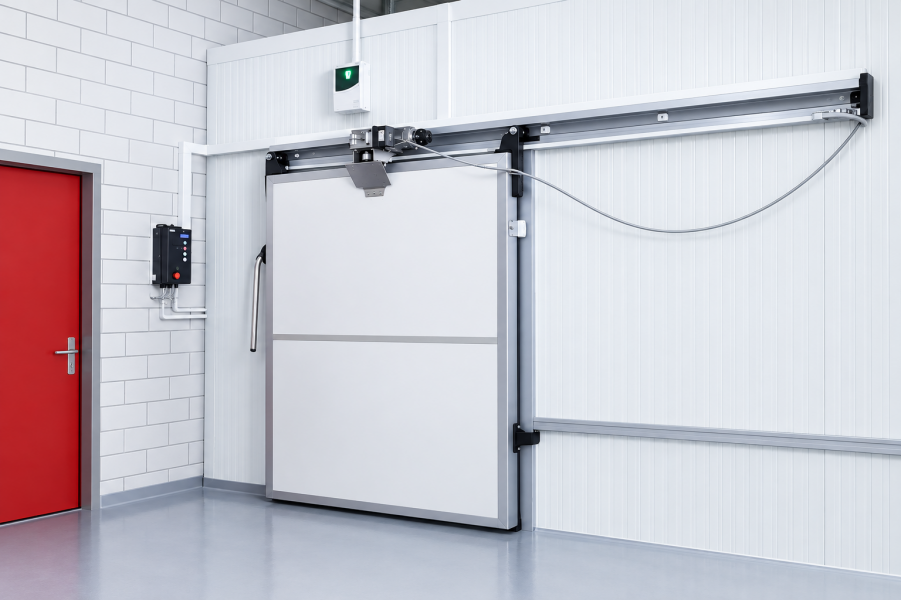
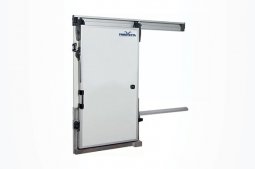
An automatic sliding cold room door provides motor-driven access to refrigerated storage without requiring users to move the insulated leaf by hand. The leaf slides horizontally beside the opening, eliminating the swing clearance required by a hinged door.
Single-slide and bi-parting configurations accommodate different entrance layouts. The opening arrangement is selected according to available wall space and passage requirements, while the thermal specification matches the chilled or frozen storage application.
Single-Leaf Automatic Sliding Door
A single-leaf automatic sliding door moves one insulated panel to one side of the entrance. This configuration suits layouts with sufficient lateral clearance on the selected opening side.
The travel direction should be coordinated with nearby walls, racking and equipment. Installation space must accommodate the full leaf movement, supporting track and drive assembly.
For entrances used by trolleys, pallet trucks or other handling equipment, clear passage dimensions should account for the load as well as the vehicle carrying it.
Bi-Parting Automatic Sliding Door
A bi-parting automatic sliding door uses two insulated leaves that move away from the centre in opposite directions. This distributes the required parking space between both sides of the entrance.
The arrangement can suit wider openings where one side cannot accommodate a full-width sliding leaf. Both sides still require sufficient wall space and track clearance.
Bi-parting describes the opening configuration. The insulation, sealing and heating requirements remain tied to the selected cold-room application.
Motorised Access and Control
Motor-driven operation reduces manual door handling at entrances used repeatedly during receiving, preparation or dispatch. The drive and controls should match the leaf size, expected opening frequency and traffic pattern.
Push-button, motion-sensor or remote activation can be considered when specifying the system. Availability must be confirmed for the selected configuration.
Opening commands and closing protection perform different functions. Protective detection, manual release and operation during power loss should be established separately in the control specification.
Where timed closing is provided, the delay must allow users and loads to clear the entrance before the closing sequence begins.
Chiller and Freezer Applications
For walk-in cold rooms, the insulated door assembly should match the storage temperature, surrounding conditions and frequency of access.
For freezer applications below −18°C (−0.4°F), Frigovetta uses door heaters to help prevent the seals from freezing. The selected automatic door’s temperature rating, heating arrangement and electrical requirements must be established for the installation.
Doors serving walk-in freezers should be specified with ambient humidity and repeated exposure to warmer air in mind. Insulation helps limit heat transfer through the closed leaf, while appropriately configured opening and closing controls can help avoid unnecessary open time.
Installation and Project Planning
Coordinate the door frame, track and drive assembly with the supporting structure and insulated cold room panels. Allow access for inspection, adjustment and maintenance.
Where powered operation is unnecessary, manual sliding cold room doors provide an alternative for consideration.
Send Frigovetta Refrigeration System your opening dimensions, room temperature, expected opening frequency and traffic details to discuss a suitable automatic sliding cold room door.
Configuration Overview
| Feature | Specification |
|---|---|
| Product type | Automatic sliding cold room door |
| Manufacturer | Frigovetta Refrigeration System |
| Operation | Motor-driven horizontal sliding |
| Opening configurations | Single-slide or bi-parting |
| Single-slide movement | One insulated leaf moves to one side |
| Bi-parting movement | Two insulated leaves move apart from the centre |
| Thermal application | Chilled or frozen storage, according to selected specification |
| Freezer heating provision | Door heating for applications below −18°C (−0.4°F) to help prevent seal freezing |
| Activation method | Specified for the selected control system and traffic requirements |
| Closing controls | Sequence and timing established for the selected system |
| Protective devices and manual release | Equipment and functions confirmed in the project specification |
| Installation clearance | Leaf travel, track, drive assembly and maintenance access |
| Dimensions and operating limits | Defined by the selected model specification |
Insulation thickness, surface materials, electrical supply, opening speed and protective equipment must be confirmed for the selected configuration.
- Reduced manual handling: Motor-driven movement removes the need to slide the insulated leaf by hand.
- Clear swing area: Horizontal travel avoids a hinged leaf projecting into the approach.
- Flexible entrance layouts: Single-slide and bi-parting configurations accommodate different lateral-space arrangements.
- Controlled access cycles: Where configured, opening and closing settings support a repeatable passage sequence.
- Insulated separation: The closed door leaf helps limit heat transfer between refrigerated storage and adjoining areas.
- Freezer seal protection: Door heaters help prevent seal freezing in applications below −18°C.
Galeri
.pdf.png)